Yoga studio
Project in progress
Location: Bretagne, France
Lead architect
Private client

Temperate oceanic climate (Koppen Cfb)
Average temperatures:
18-19°C in summer, 6-7 °C in winter
Rainfall: ~800–900 mm, distributed throughout the year
Wind: ~18km/h predominantly west/southwest along the coast
Relative humidity generally high (85-90%)
Risk of runoff, strong winds, frequent rain

"Designing sustainable leisure spaces, adapted to their climatic context"
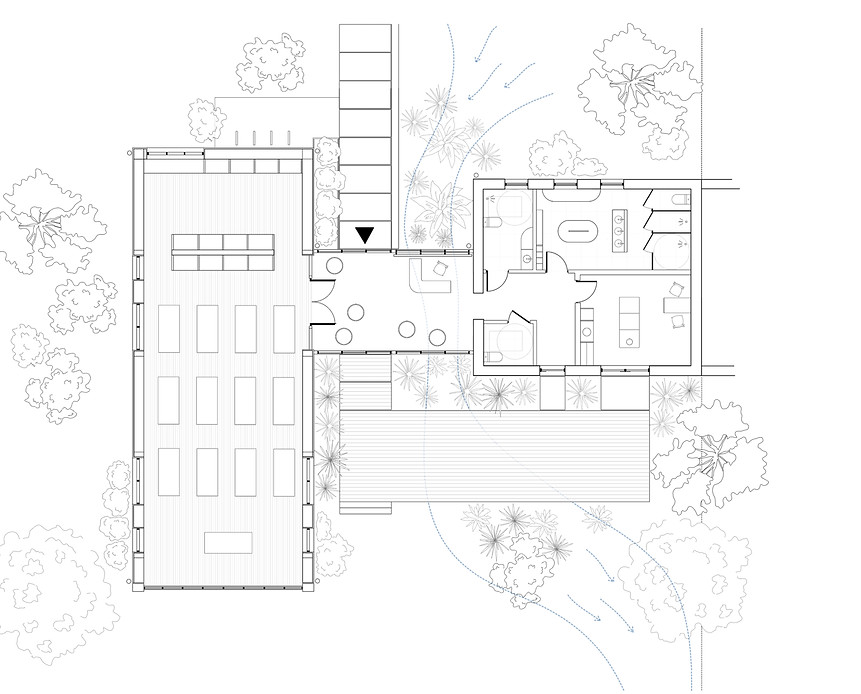
Born from the renovation of an old farmhouse, this contemporary yoga studio contributes to the revitalization of a degraded site, by enhancing the existing structures and their territorial identity.
The original building is preserved and renovated to accomodate changing rooms and consultation spaces (massage, therapies), while a new volume has been inserted beneath a large wooden frame, as a yoga barn.
A transitional reception space creates a seamless link between the old and the new, ensuring continuity in both use and circulation.
The project adopts a bioclimatic approach adapted to the local climate, characterized by its humidity, prevailing winds, and variable daylight conditions. The building's orientation, openings, and solar protections are designed to capture solar gain in winter while limiting overheating in summer and to promote controlled natural ventilation. The thermal mass of the materials also contribute to thermal comfort.
The site's sensitivity, linked to its flood-prone nature, is fully integrated into the design. The buildings are slightly elevated above the natural ground level, allowing water flows from the watershed to pass through during heavy rainfall events. This strategy turns hydrological constraints into a structuring element of the landscape design.
The landscape therefore plays a central role: local species, adapted to the climate, compose a welcoming and protective garden. Dense in summer to shade the facades, it becomes more permeable in winter, allowing low sunlight to penetrate and contributing to thermal comfort.
Finally, the project promotes a responsible approach through the reuse of materials sourced from the site or local suppliers. Existing elements are reinterpreted, reducing the carbon footprint of the intervention while preserving the memory of the place.