What is Bioclimatic and Resilient Architecture?
At a time when climate disruptions are intensifying, the conditions under which we design and inhabit buildings are undergoing profound change. More frequent heatwaves, extreme rainfall events, violent winds, and prolonged droughts are reshaping the environmental balance to which architecture must respond. The challenge is no longer simply to withstand climatic constraints, but to integrate them as genuine drivers of design.
In this context, bioclimatic and resilient architecture emerges as an essential approach, capable of reconciling comfort, performance, and site-specific adaptation. It is based on a simple principle: leveraging the natural conditions of a site rather than systematically compensating for them through technical systems, in order to create buildings that are more efficient, more sustainable, and more comfortable.
This approach is grounded in several fundamental principles:
1/ Building orientation
Orientation is one of the most decisive factors in bioclimatic design. It directly influences solar gains, ventilation conditions, and overall thermal comfort.
In temperate climates, orienting openings to the south allows buildings to capture solar heat and daylight in winter, while controlling solar gains in summer through appropriate shading devices. This exposure promotes passive solar gains and can significantly reduce heating demand—provided it is paired with effective solar protection to prevent overheating. In a typical dwelling, heating can account for up to 60–70% of total energy consumption. Well-designed bioclimatic strategies can reduce these needs by 30–50%, depending on the project.
In tropical climates, the challenge shifts: the priority is to limit direct solar gains and enhance natural ventilation. Ventilation relies on pressure and temperature differentials between indoor and outdoor environments, as well as prevailing winds. It plays a key role in thermal comfort and indoor air quality, while reducing reliance on air conditioning and mechanical ventilation systems.
Architectural design is critical here: the placement, orientation, size, and relationship of openings enable effective cross-ventilation. In hot and humid climates, natural ventilation becomes a structuring principle, helping to dissipate heat and regulate indoor humidity.
In all cases, orientation must be defined in relation to the specific characteristics of the site and local climate, as it conditions all architectural decisions. Several tools are mobilized from the earliest design stages: solar diagrams to track the sun’s path across seasons, wind roses to identify prevailing wind patterns, and solar exposure and shading studies to assess sunlight and shadow conditions. Today, digital simulation tools further refine these analyses by modeling environmental and thermal performance. Field surveys and contextual analysis complete this approach by integrating real site constraints such as existing buildings, topography, vegetation, and surrounding obstacles.
A bioclimatic house in La Reunion:

2/ The role of landscape design
Vegetation plays a central role in bioclimatic design. It acts as a thermal regulator, environmental filter, and stormwater management tool. According to ADEME, well-designed vegetation can reduce perceived temperatures around buildings by 2 to 8°C and lower cooling needs by up to 20% in summer.

In tropical climates, vegetation helps create favorable microclimates by providing shade, mitigating urban heat island effects, and improving both outdoor and indoor comfort. Layered planting—combining canopy trees, shrubs, and ground cover—can reduce direct solar radiation on façades by up to 50%, while enhancing natural ventilation and evapotranspiration, lowering ambient temperatures by 3 to 5°C.
In temperate climates, vegetation is often used seasonally. Deciduous trees provide effective shading in summer while allowing sunlight to penetrate in winter after leaf fall. This natural modulation of light and shade helps regulate indoor thermal comfort and can reduce heating and cooling energy demand by 10 to 15%.
Landscape design also plays a key role in stormwater management. By promoting infiltration, limiting runoff, and integrating systems such as swales, rain gardens, and permeable surfaces, vegetation contributes to on-site water regulation. In tropical regions, where rainfall can reach 200 to 300 mm per day during extreme events, these systems are essential to absorb water volumes, limit erosion, and prevent soil saturation.
Far from being merely aesthetic, vegetation becomes a true design tool, at the intersection of climatic, hydraulic, and environmental challenges. It actively contributes to energy performance, user comfort, and building resilience, while strengthening the relationship between architecture and its context.
3/ Thermal mass
Material selection is crucial, particularly when optimizing a building’s thermal mass.
Thermal mass refers to a material’s ability to store heat and release it gradually, thereby smoothing indoor temperature variations. In temperate climates, high-mass materials such as concrete, stone, or rammed earth absorb solar gains during the day and release them as temperatures drop, improving comfort while reducing heating and cooling demands.
In tropical climates, where overheating and humidity are the primary concerns, thermal mass must be used carefully and combined with effective ventilation and solar protection strategies to avoid heat buildup. In such contexts, lighter construction systems that promote rapid heat dissipation are often more appropriate.
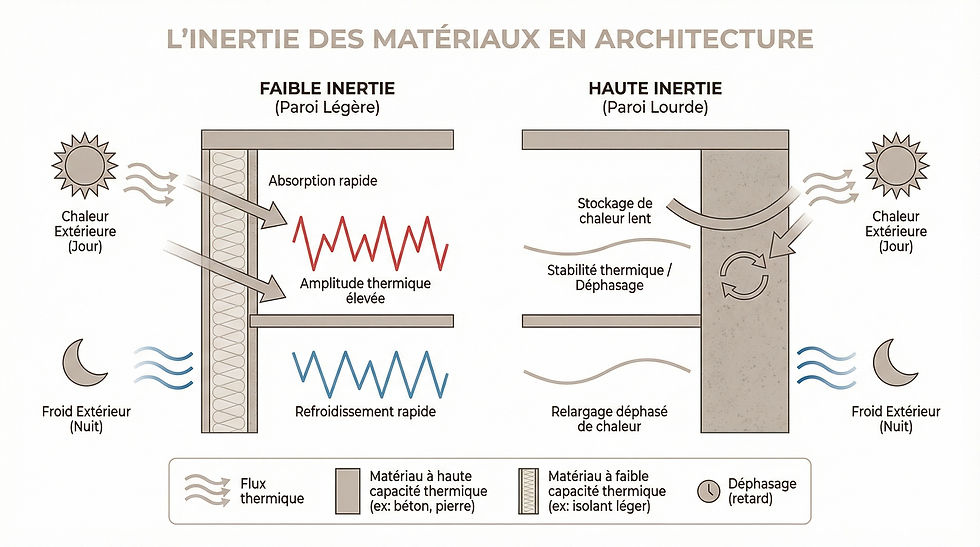
The building envelope, as the interface between interior and exterior, plays a decisive role in overall performance. Thermal insulation, airtightness, thermal bridge treatment, and the quality of walls, roofs, and glazing are all key components of bioclimatic design.
Material selection must also go beyond thermal properties to include durability, resistance to climatic conditions (humidity, salinity, temperature variations), local availability, and environmental impact. Bio-based, geo-based, and reclaimed materials are therefore increasingly favored as part of a responsible, context-driven design approach.
When properly integrated into a global strategy, thermal mass becomes a powerful passive regulation tool, contributing to stable indoor environments and reduced energy consumption.
4 / Resilient Architecture: Anticipate, Adapt, Endure
Resilient architecture designs buildings that can anticipate, withstand, and adapt to natural hazards and evolving climatic conditions. Rather than resisting site constraints, it incorporates them from the outset, transforming risks into defining elements of the project.
Flooding, extreme winds, ground movement, and severe weather events are not merely tolerated—they are anticipated and addressed in every architectural decision. This approach reduces building vulnerability while ensuring user safety and comfort.
The key lies in a detailed site analysis: understanding local climate, identifying natural hazards, analyzing topography and watersheds, studying soil conditions, and assessing exposure to wind and water. Based on these insights, architects adapt building placement, structural systems, materials, and protective strategies.
Bioclimatic and resilient architecture does not rely on a single model. It is inherently contextual and site-specific, with each project emerging from a careful reading of climate and territory. Integrating these principles from the earliest design stages enhances comfort, secures investment, reduces operational costs, and extends building lifespan.
In a rapidly changing world, architecture has a strategic role to play. By redefining its relationship with climate and place, it becomes a powerful lever for adaptation—serving the creation of more sustainable, balanced, and equitable environments.


